Don’t Make Up Your Buyers Mind For Them
One of the most expensive mistakes leaders make is deciding they already know the answer before the conversation begins.
I've seen it happen in sales meetings, investor discussions, hiring decisions, partnership opportunities, and strategic conversations between CEOs.
Someone looks at the situation and creates a story:
"They won't buy."
"They're not ready."
"They're too small."
"They already have a solution."
"They probably aren't serious."
The problem isn't that these assumptions might be wrong.
The problem is that once you've made them, you stop listening.
You start filtering everything through a conclusion you reached before the conversation even started.
And that's where opportunities get missed.
Curiosity Creates Opportunity
The best leaders I've worked with share a common trait.
They stay curious longer.
Instead of walking into a conversation trying to prove themselves right, they walk in trying to understand what is actually happening.
Because most business problems are not presented clearly.
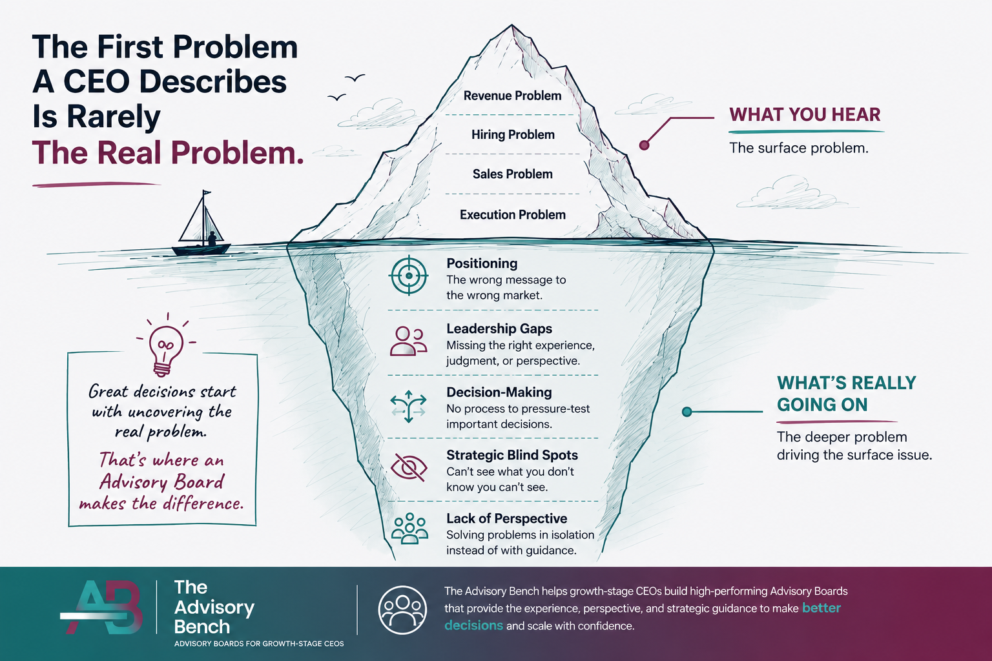
A CEO may believe they have a revenue problem when they actually have a positioning problem.
They may think they need to hire faster when what they really need is stronger leadership around a critical function.
They may believe they need more execution when the real issue is a lack of perspective before making important decisions.
The challenge is that you'll never uncover the real problem if you've already decided what the answer must be.
The Opportunity Is Usually Beneath The Surface
Most meaningful business conversations start with a symptom, not the root cause.
That's true whether you're talking to customers, investors, employees, or advisors.
The first thing someone tells you is rarely the full story. That's why great leaders ask questions before offering solutions.
They listen.
They probe.
They challenge assumptions.
They look beyond the obvious.
Not because they have all the answers, but because they understand that clarity comes from conversation.
The real opportunity often sits underneath the problem that was initially presented.
Don't Let Assumptions Limit Growth
As companies grow, assumptions become more dangerous.
Founders begin relying on pattern recognition. Executives trust their experience. Teams move faster. Decisions happen with less discussion.
While experience matters, it can also create blind spots.
The more convinced you are that you already know what's happening, the less likely you are to discover something important.
That's why the strongest leaders actively seek perspectives that challenge their thinking.
They create environments where assumptions can be tested before decisions are made.
They understand that confidence and curiosity are not opposites.
The best leaders operate with both.
Why Perspective Matters
This is one of the reasons Advisory Boards can be so valuable.
Most CEOs don't wake up thinking they need an Advisory Board.
They wake up thinking:
- I have a decision I can't afford to get wrong.
- I need experience that doesn't exist inside my company.
- I need to see around corners.
- I need people who have navigated this stage before.
- I need a better way to pressure-test important decisions.
The Advisory Board is not the objective. Better decisions are.
The right advisors help leaders challenge assumptions, identify blind spots, and see opportunities they might otherwise miss.
Sometimes the greatest value isn't the answer.
It's having someone ask the question you didn't know you needed to consider.
Don't make up someone else's mind before they've had the chance to tell you what's really happening.
Approach important conversations with curiosity.
Assume there's something worth understanding.
Listen before diagnosing.
Ask before prescribing.
The leaders who consistently uncover the best opportunities are rarely the ones with the fastest answers.
They're the ones willing to stay curious long enough to find the right question.
A Question To Consider
Where might assumptions be limiting your ability to see the real opportunity in front of you?
If you want to learn more about what we do and how we help CEOs make better decisions, explore how The Advisory Bench works, or start a conversation with me.
Because sometimes the difference between a good decision and a great one is having the right people around the table.
On We Go,
Chris