
Filling Your Talent Gap
“Who do we need next?”
CEOs ask me this all the time: Who do we need next? A CRO? A COO? A CFO? A CTO? Somebody to “own” sales, operations, finance, technology or growth? Maybe. But maybe not. That’s where companies get themselves into trouble. They feel the pain, they give the pain a title, they start recruiting.
I understand why. When a company is growing, something is usually stretched. Sales gets unpredictable. Delivery gets messy. The CEO is still pulled into way too many decisions. The numbers aren’t as clear as they should be. Your team is working hard, but the business feels much heavier than it used to. So the natural reaction is, “We need to hire someone.” Sometimes that’s right. But not always.
Instead of asking, “What title are we missing?” the better question is: “What experience do we need around the next decision?” That’s a very different conversation.
The Team May Be Excellent. That Doesn’t Mean It’s Complete.
The team that got you here may be excellent, loyal, smart, scrappy, committed, and the reason the company exists at all. That doesn’t mean they’re the team you need for the next stage.
This can be a hard conversation for CEOs because it feels personal, but it isn’t. It’s just business reality. A company doing $5 million doesn’t need the same kind of leadership capacity as a company trying to reach $25 million. A company entering a new market doesn’t need the same experience as one doubling down on its current customers. A company getting ready to raise capital needs a different kind of financial judgment than a company that needs to tighten operations and preserve cash.
The business changes. The decisions change. So the experience around the table has to change, too. That doesn’t mean everyone needs to be replaced. It doesn’t mean the original team failed. It means the company has reached a point where effort alone won’t solve everything. Most teams are already working hard. The question is whether they’ve seen the next problem before.
The Biggest Pain Isn’t Always The Real Constraint.
When CEOs ask, “Who should we hire next?” I’d usually slow that down a bit. Not because hiring isn’t important. It most definitely is. But hiring against the wrong problem is expensive.
The biggest pain in your business isn’t always the real constraint. You think you need a sales leader because revenue feels inconsistent. But the real issue might be positioning, pricing, an offer that isn’t clear or sales process that depends too much on the founder. You think you need a COO because operations feel messy. But the real issue might be decision rights, accountability, or systems that were fine at $10 million and completely inadequate at $30 million. You think you need a CFO because the numbers are frustrating. But the real issue might be that the company hasn’t defined the financial decisions it needs to make at this stage.
So before you hire, ask:
- What’s actually slowing us down?
- What decision are we trying to improve?
- What problem keeps showing up over and over?
- What experience isn’t in the room?
- What are we guessing about?
That last one is important. If the leadership team is guessing on a high-stakes decision, you’ve probably found the talent gap.
Sometimes The Solution Is Too Heavy.
Not every expertise gap requires a permanent hire. Sometimes it does. If the business needs daily leadership in a function, clear ownership, team building, process, discipline, and execution, then yes, hire the executive. But sometimes the company doesn’t need a full-time person yet. Sometimes it needs six hours a month with someone who has solved the exact problem before. Sometimes it needs a fractional leader. Sometimes it needs an advisor. Sometimes it needs a board member. Sometimes it needs one person in the room for one very important decision.
That’s not being cheap. It’s being thoughtful. I’ve seen companies hire big titles too early. It rarely works well. The executive gets frustrated because the company isn’t ready. The CEO gets frustrated because the hire doesn’t magically fix the problem. The team gets confused because now there’s more cost, more structure, and not always more clarity. The issue was real. The solution was just too heavy.
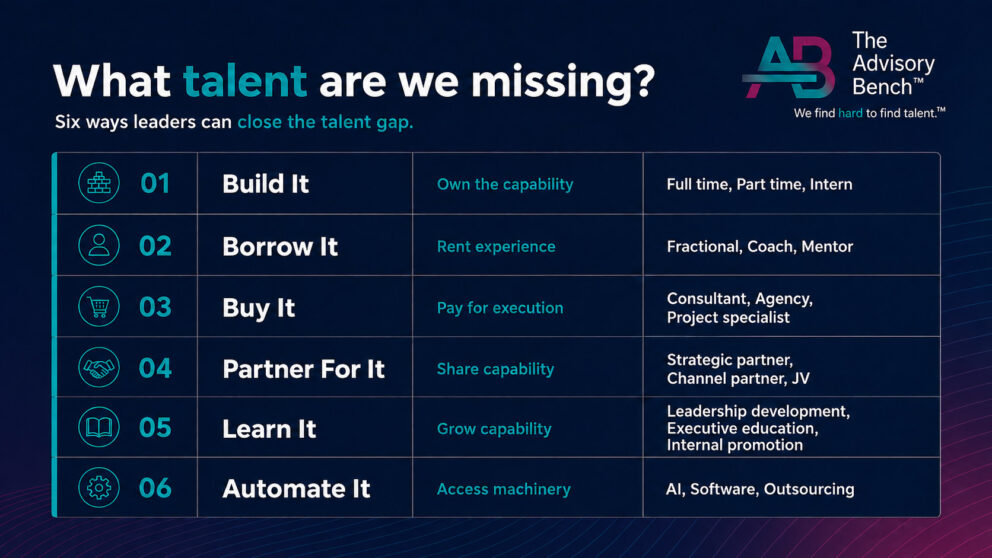
That’s why I like the idea of a bench. A bench gives you access to experience before you need to put every bit of that experience on payroll. There are a lot of ways to get the talent you need without it being a hire right off the bat.
Start With The Decision. Not The Org Chart.
Here’s a simple way to pressure-test the talent gap. Start with the next major decision the company needs to make. Not the org chart. The decision.
Are you trying to enter a new market? Raise capital? Build a more repeatable sales engine? Remove a growth bottleneck? Figure out whether the CEO has become the bottleneck?
Now ask: Has anyone on our leadership team made this decision before? Does anyone understand the economics? Does anyone know this market from experience? Does anyone know what usually breaks next? Does anyone in the room have enough distance to challenge our assumptions?
If the answer is no, that’s your gap. Now you can decide how to fill it.
Maybe it’s a hire. Maybe it’s an advisor. Maybe it’s a fractional executive. Maybe it’s an Advisory Board member. Maybe it’s someone you bring in for a very specific conversation. The format matters less than the experience.
Titles Sound Like Answers. Experience Is More Specific.
One of the questions I like is: If you could borrow one person’s experience for the next six months, who would it be?
That gets people out of job titles and into real needs. Because you may not need “a COO.” You may need someone who has scaled a services company without breaking delivery. You may not need “a CFO.” You may need someone who has raised growth capital, cleaned up reporting, and helped a CEO understand what the business can afford to do. You may not need “a CRO.” You may need someone who has built a repeatable sales process in your market.
That’s a better way to think. Titles can make people lazy. They sound like answers.
Experience is more specific. What has this person actually seen? What decisions have they made? What mistakes can they help us avoid? Where can they see around corners because they’ve been there before? That’s what you’re really buying. Not a title. Pattern recognition.
A Vanity Board Looks Nice. A Real Bench Helps.
Here’s another simple test: Is your leadership bench stronger today than it was a year ago?
If the business has grown but the bench hasn’t, pay attention. Because the decisions probably got bigger. The consequences probably got much more expensive. The market probably got more complicated. The team probably has more on its plate. And the CEO is probably carrying more than anyone wants to admit. A stronger bench does not mean collecting impressive names.
That’s how you end up with what I’d call a vanity board. Looks nice... Doesn’t do much.
A stronger bench means the CEO has access to useful people around real decisions. Someone who understands the market you’re entering. Someone who can tell you if your sales process is actually repeatable. Someone who knows whether you have a capital problem, a strategy problem, or an execution problem. Someone who can help you decide if the next hire should be full-time, fractional, advisory, or not a hire at all. Someone who can ask the question nobody else is asking.
That’s useful. That changes the conversation. And better conversations usually lead to better decisions.
Get The Right People Around The Right Problem.
This reminds me of a principle I’ve used for years: “Yes, we do that.”
When a good customer brings you a real problem, but it’s not exactly your lane, you don’t automatically say, “That’s not what we do.”
You say, “Yes, we do that.” Then you figure it out.
Now, that only works if you have smart people around you. I’ve said this before: smart people can figure things out. But the important part is not just having smart people in general. It’s having the right smart people around the right problem. People who don’t make simple things complicated. People who listen to customers and understand what’s really being asked. People who can tell the difference between a distraction and an opportunity.
People who can say, “I’ve seen this before, and here’s what matters.”
That’s what filling a talent gap is really about. It’s not about adding another box to the org chart. It’s about making sure the company has the experience it needs before the next decision gets expensive. The best CEOs know they’re not supposed to know everything. That’s not the job.
The job is knowing when the company needs experience it doesn’t currently have. Sometimes that means hiring. Sometimes it means borrowing the expertise. Sometimes it means building an Advisory Board that gives the CEO access to people who have already solved similar problems.
Don’t hire the title. Solve the constraint. If the company is facing a decision it hasn’t made before, get someone in the room who has.
Consider
What experience is missing from your leadership team right now? And does it need to be a hire or can it be filled in other creative ways? Need someone to bounce your ideas off? Let's Start a Conversation.