
Why Aren’t They Buying?
Five signals that selling harder isn’t the solution, plus the questions to ask before you spend more on leads, campaigns or adding salespeople.
One of the most frustrating questions in a growing company is also one of the most useful: why aren’t they buying?
If you’re leading the company, that question can feel personal. You may have a good team, a good product, real activity in the market, and still the deals don’t move the way you expected. Prospects take meetings, seem interested, ask for information, maybe even say all the right things. Then the process slows down or goes quiet.
When that happens, the natural reaction is to look for more. More leads. More calls. More follow-up. More campaigns. More sales pressure. Sometimes that’s exactly what’s needed. But sometimes the buyer is giving you information that is more useful than another campaign would be.
If people aren’t buying, the solution may not be to sell harder. It may be to listen better.
The Issue: It May Not Be a Sales Problem
When customer growth slows, it’s understandable to call it a sales problem. Sales is where the pain shows up. The pipeline isn’t moving. Deals are taking too long. Prospects seem interested, then disappear. Everybody wants more qualified opportunities, more urgency, and more wins.
But a lot of “sales problems” are really something else. They may be positioning problems. Pricing problems. Trust problems. Market problems. Offer problems. Fit problems. Sometimes the company is doing plenty of selling, but the buyer still doesn’t clearly see why this matters enough to act now.
That distinction matters because a good team can work very hard on the wrong issue. You can push harder on sales activity when the real issue is that the value is not clear. You can buy more leads when the real issue is that you’re talking to the wrong buyer. You can hire more salespeople when the real issue is that the offer still asks the buyer to do too much translation.
That doesn’t mean anyone has failed. It means the company has something to learn.
The Answer: Understand the Real Conversation
I have a simple rule about sales conversations: don’t make up the buyer’s mind before the buyer has had a chance to talk. I’ve seen people go into a meeting already saying, “I don’t think they’re going to buy.” That is a hard way to listen well, because you’ve already started protecting yourself from rejection instead of trying to understand the buyer’s real problem.
If someone agreed to meet with you, there is probably a reason. They may not need exactly what you thought you were going to sell. They may not want the round thing. They may need the square thing. That’s okay. You can make a square. But you’ll never learn that if you walk in assuming the answer is already no.
A good sales conversation is not just a pitch. It is a diagnostic.
The buyer may not have perfect language for the problem yet. They may describe a symptom. They may think they need one thing when the real issue is underneath it. Your job is not to force them into your original offer. Your job is to understand what they are trying to solve and whether you can help.
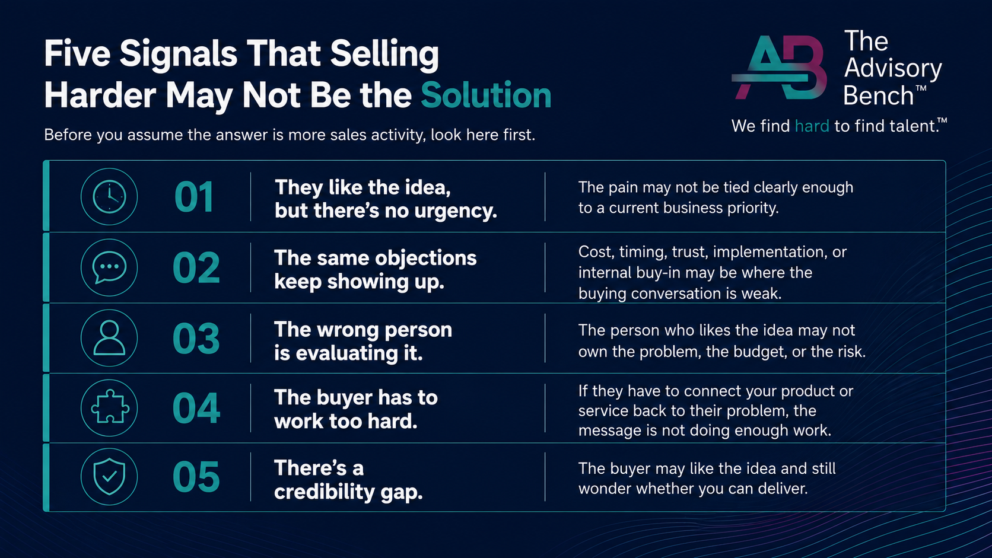
Five Signals That Selling Harder May Not Be the Solution
Here are five places I would look before assuming the answer is simply more sales activity.
- Prospects like the idea, but they don’t feel urgency. They may understand what you do, but the pain is not strong enough yet. That usually means the conversation needs to connect more clearly to a current business priority.
- The same objections keep showing up. If buyers keep hesitating around cost, timing, trust, implementation, or internal buy-in, don’t treat those as random objections. They are telling you where the buying conversation is weak.
- The wrong person is evaluating the solution. Sometimes the person who likes the idea is not the person who owns the problem, the budget, or the risk. That does not mean the opportunity is bad. It may mean you are in the wrong room.
- The buyer has to work too hard to understand the value. If you explain the product, the service, or the process and expect the buyer to connect it back to their own problem, you are making them do too much work. The buyer should not have to figure out why you matter.
- There is a credibility gap. The buyer may like the idea and still wonder whether you can deliver. For growing companies, trust is part of the sale.
That last point is important. Early in my career, when I was calling from P&G, people called me back. Of course they did. The brand had already created credibility before I ever opened my mouth.
Then I left and started building companies on my own. Different world. Nobody owed us a return call. We once called a prospect so many times that he probably had a stack of message slips from us. Eventually we got the meeting, he liked what we had, and he became a significant customer. But the lesson stayed with me: when you don’t have a giant brand behind you, you must earn the right to be heard.
That is true for a lot of growing companies. The buyer may like the idea, but they still must believe you understand their world, can deliver what you promise, and are worth the risk of change. If that trust is not there yet, the deal may stall even when the need is real.
Before You Spend More, Ask Better Questions
Before a company spends more money on marketing, adds more salespeople, or launches another campaign, I would want the leadership team to answer a few questions honestly.
- Do we know why our best customers choose us?
- Do we know why serious prospects choose not to buy?
- Are we selling to the right buyer inside the right kind of company?
- Can we explain the value in the buyer’s language, not ours?
- Do prospects believe the problem is urgent enough to act now?
- Do we have a trust gap, a value gap, a timing gap, or a fit gap?
- Are we learning from lost deals, or just replacing them with more leads?
These are not complicated questions. But they do require a leadership team to slow down long enough to look at what is really happening between interest and decision. That is often where outside perspective helps. Someone who has built a repeatable customer growth engine before can usually see the difference between a sales issue, a positioning issue, a market issue, and a credibility issue faster than the team living inside it every day.
Don’t Fall in Love With the Offer
This goes back to another lesson I’ve learned over time: fall in love with your customers, not your product. Or your service. Or your process. Or the way you’ve always described the company.
A lot of companies get stuck because they are too attached to the offer. They built it, named it, put it on the website, made the deck, trained the team, and now every conversation has to fit inside that box. But customers don’t care about the box. They care about the problem.
So when buyers aren’t buying, one of the most useful questions is: are we talking about the problem the way the customer experiences it? Not the way we organize it internally. Not the way our sales deck explains it. Not the way our team thinks about it. The way the customer feels it, names it, budgets for it, and decides whether it is worth solving now.
The buyer doesn’t buy your internal logic. The buyer buys the value they can understand, trust, and act on.
The Best Sales Organizations Listen Better
If they’re not buying, don’t assume why. And don’t assume the answer is just more activity. Assume the buyer is telling you something useful, even if they are telling you through silence, delay, objections, or a no.
Maybe they don’t trust you yet. Maybe the value is not clear. Maybe the timing is wrong. Maybe you are talking to the wrong person. Maybe you are selling the round thing and they need the square thing. Maybe the problem is real, but your current offer does not quite meet it.
That is information. Use it.
The best companies don’t just push harder. They listen better. They learn why customers buy, why they don’t, and what has to change for the conversation to become more useful.
At The Advisory Bench, we help growth-stage CEOs build the right bench around the decisions that matter most, including how to create more value, get more customers, and understand what is really slowing growth. Not generic advice. The right people in the room for the questions the CEO cannot afford to guess on.
Consider
Do you really understand why they aren’t buying? And is your team answering that question with real customer insight, or just more activity?
These are great questions. Let's Start a Conversation.